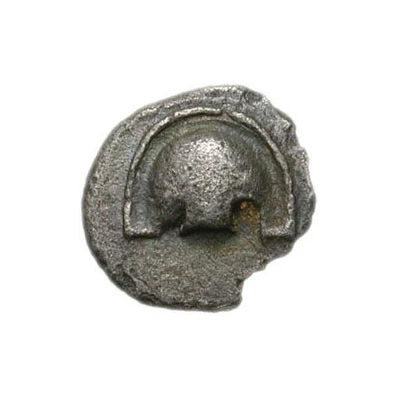
© Classical Numismatic Group, Inc.
© Classical Numismatic Group, Inc.
Hemiobol 400 BC - 375 BC
| Silver | 0.41 g | - |
| Issuer | Haliartos (Boeotia) |
|---|---|
| Type | Standard circulation coin |
| Years | 400 BC - 375 BC |
| Value | Hemiobol (1⁄12) |
| Currency | Drachm |
| Composition | Silver |
| Weight | 0.41 g |
| Shape | Round (irregular) |
| Technique | Hammered |
| Demonetized | Yes |
| Updated | 2024-10-09 |
| Numista | N#146623 |
|---|---|
| Rarity index | 100% |
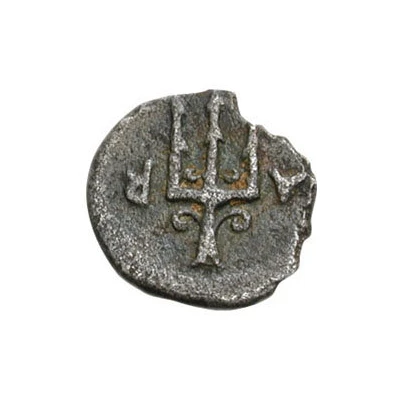
Reverse
Trident facing downwards between the letters A-R. All within concave circle
Interesting fact
The Hemiobol coin from Haliartos (Boeotia) was used as a form of currency in ancient Greece during the 4th century BC. Its name "Hemiobol" comes from the Greek words "hēmi-" meaning "half" and "bolos" meaning "throw", which refers to the coin's value being equal to half the value of a full "bolos" coin. Despite its small value, the Hemiobol was widely used in everyday transactions and was an important part of the ancient Greek economy.