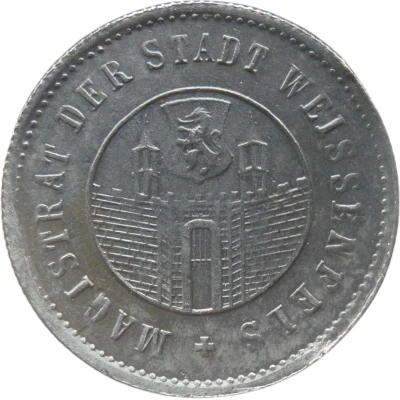
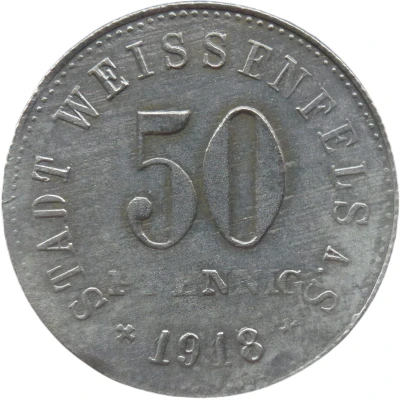
© Willem63 (CC BY-NC-SA)
© Willem63 (CC BY-NC-SA)
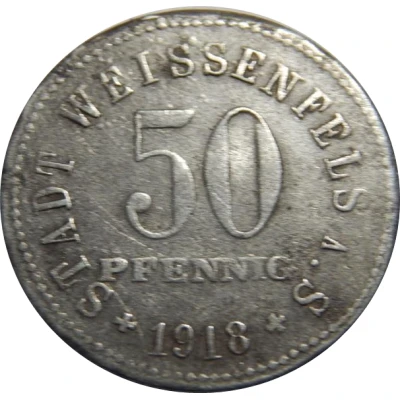
50 Pfennigs - Weissenfels an der Saale
1918 year| Zinc | 2.9 g | 24.2 mm |
| Issuer | City of Weißenfels (Prussian province of Saxony) |
|---|---|
| Type | Standard circulation coin |
| Year | 1918 |
| Value | 50 Pfennigs (50 Pfennige) (0.50) |
| Currency | Mark (1914-1924) |
| Composition | Zinc |
| Weight | 2.9 g |
| Diameter | 24.2 mm |
| Thickness | 1.3 mm |
| Shape | Round |
| Technique | Milled |
| Orientation | Medal alignment ↑↑ |
| Demonetized | Yes |
| Updated | 2024-10-04 |
| Numista | N#175446 |
|---|---|
| Rarity index | 87% |
Reverse
Pearl rim, legend surrounding denomination.
Script: Latin
Lettering:
STADT WEISSENFELS A.S
50
PFENNIG
✠ 1918 ✠
Edge
Reeded
Comment
Issuing agency: [Stadt, Provinz Sachsen].Old Funck version: 589.3

Interesting fact
One interesting fact about the 50 Pfennigs - Weissenfels an der Saale 1918 coin is that it was issued during a time of economic turmoil in Germany, known as the "Inflationary Period" (1914-1924), when the value of the German mark was rapidly decreasing due to the country's involvement in World War I and the subsequent economic crisis. As a result, many different types of coins were issued during this time, including the 50 Pfennigs coin made of zinc, which was a cheaper alternative to traditional metals like silver or gold. Despite its low value, the coin remains a unique and interesting piece of numismatic history.