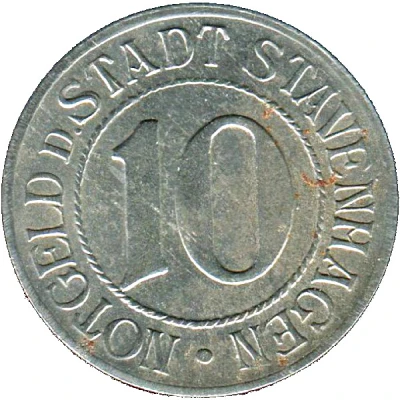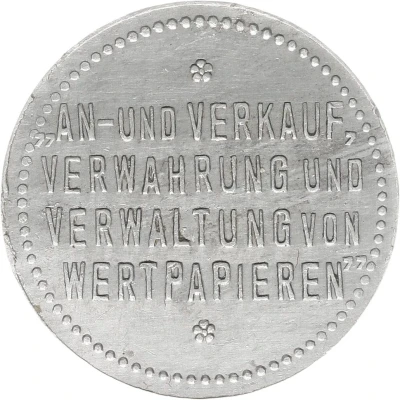
© Willem63 (CC BY-NC-SA)
© Willem63 (CC BY-NC-SA)
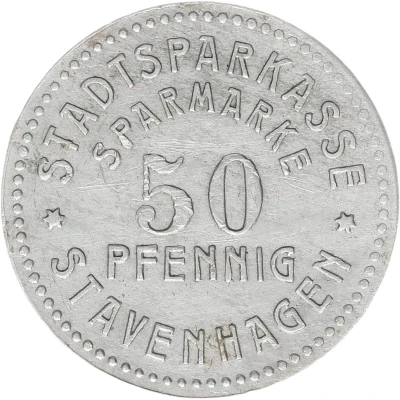
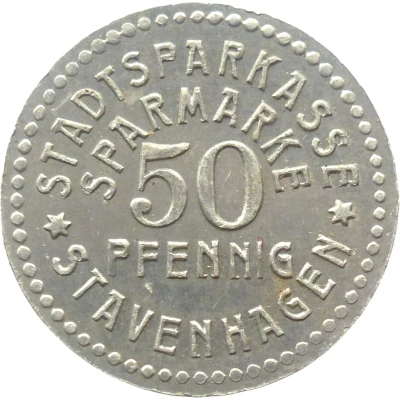
50 Pfennigs - Stavenhagen ND
1922 year| Aluminium | 0.8 g | 20.2 mm |
| Issuer | City of Stavenhagen (Federal state of Mecklenburg-Schwerin) |
|---|---|
| Issuing entity | Stadtsparkasse Stavenhagen |
| Period | Weimar Republic (1918-1933) |
| Type | Standard circulation coin |
| Year | 1922 |
| Value | 50 Pfennigs (50 Pfennige) (0.50) |
| Currency | Mark (1914-1924) |
| Composition | Aluminium |
| Weight | 0.8 g |
| Diameter | 20.2 mm |
| Thickness | 1.1 mm |
| Shape | Round |
| Technique | Milled |
| Orientation | Medal alignment ↑↑ |
| Demonetized | Yes |
| Updated | 2024-10-04 |
| Numista | N#104301 |
|---|---|
| Rarity index | 90% |
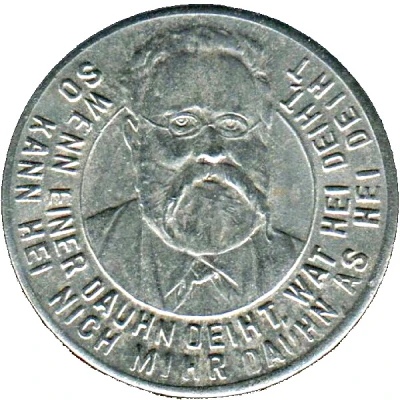
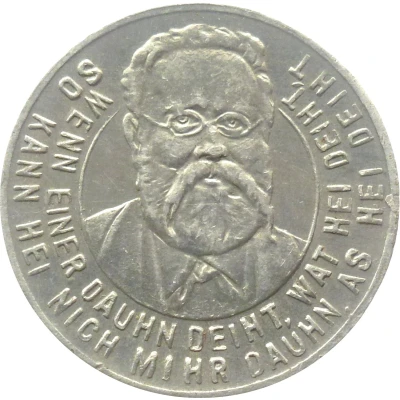
Reverse
Two line legend semi-circled under bust of Fritz Reuter
Script: Latin
Lettering:
WENN EINER DAUHN DEIHT, WAT HEI DEIHT,
SO KANN HEI NICH MIHR DAUN, AS HEI DEIHT
Edge
Plain
Comment
Issuing agency: [Stadt, Mecklenburg-Schwerin].
Interesting fact
The 50 Pfennigs coin from Stavenhagen (1922) is interesting because it was issued during a time of hyperinflation in Germany, when the value of the German mark was rapidly decreasing. As a result, many cities and towns, including Stavenhagen, issued their own emergency currency, like this coin, to serve as a stable alternative to the devalued national currency. This coin, made of aluminum and weighing only 0.8 grams, was used as a substitute for the official German currency and was accepted as legal tender in the city of Stavenhagen.