© Willem63 (CC BY-NC-SA)
© Willem63 (CC BY-NC-SA)
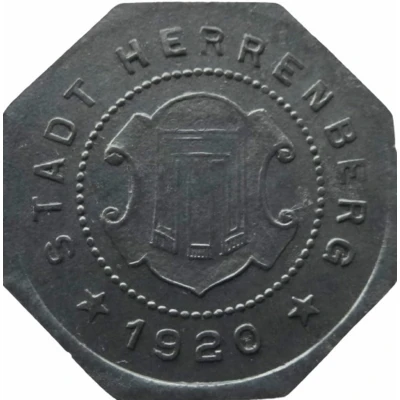
50 Pfennigs - Herrenberg
1920 year| Zinc | 2.4 g | 20.7 mm |
| Issuer | City of Herrenberg (Federal state of Württemberg) |
|---|---|
| Period | Weimar Republic (1918-1933) |
| Type | Standard circulation coin |
| Year | 1920 |
| Value | 50 Pfennigs (50 Pfennige) (0.50) |
| Currency | Mark (1914-1924) |
| Composition | Zinc |
| Weight | 2.4 g |
| Diameter | 20.7 mm |
| Thickness | 1.2 mm |
| Shape | Octagonal (8-sided) |
| Technique | Milled |
| Orientation | Medal alignment ↑↑ |
| Demonetized | Yes |
| Updated | 2024-10-04 |
| Numista | N#310656 |
|---|---|
| Rarity index | 90% |
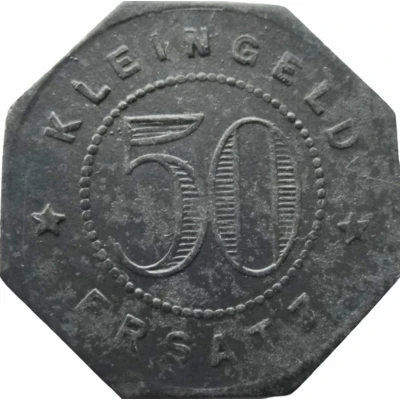
Reverse
Pearl rim surrounding, pearl circle with denomination centered
Script: Latin
Lettering:
KLEINGELD
50
★ ERSATZ ★
Edge
Plain
Interesting fact
The 50 Pfennigs - Herrenberg 1920 coin was minted during a time of economic turmoil in Germany, known as the "Inflationary Period" (1914-1924). During this time, the value of the German mark (the national currency) plummeted, and prices for everyday goods skyrocketed. As a result, many Germans turned to alternative forms of currency, such as local emergency currencies like the 50 Pfennigs - Herrenberg 1920 coin. This coin was issued by the City of Herrenberg in the Federal state of Württemberg and was made of zinc, which was a more affordable material than traditional metals like gold or silver. Despite its humble origins, the 50 Pfennigs - Herrenberg 1920 coin remains a fascinating piece of German history and a testament to the resourcefulness of the German people during a time of economic hardship.
Price
| Date | Mintage | VG | F | VF | XF | AU | UNC |
|---|---|---|---|---|---|---|---|
| 1920 | 10250 | - | - | - | - | - | - |
Values in the table are based on evaluations by sales realized on Internet platforms. They serve as an indication only for 50 Pfennigs - Herrenberg 1920 coin.