© Willem63 (CC BY-NC-SA)
© Willem63 (CC BY-NC-SA)
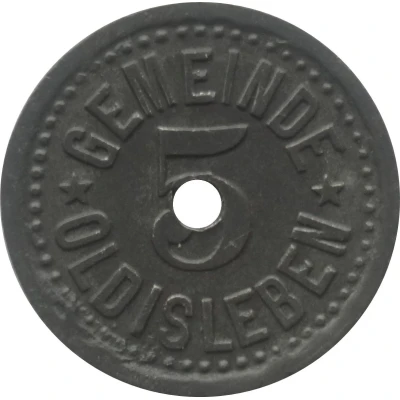
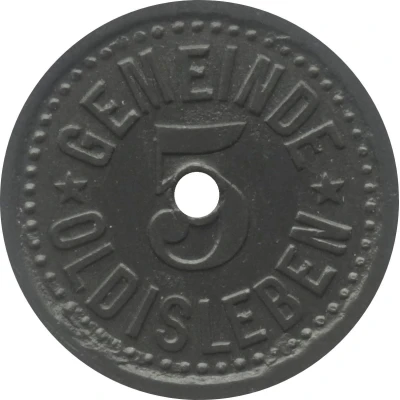
5 Pfennigs - Oldisleben ND
| Zinc | 1.5 g | 18.2 mm |
| Issuer | Municipality of Oldisleben (Saxe-Weimar-Eisenach) (Federal state of Saxe-Weimar-Eisenach) |
|---|---|
| Type | Standard circulation coin |
| Value | 5 Pfennigs (5 Pfennige) (0.05) |
| Currency | Mark (1914-1924) |
| Composition | Zinc |
| Weight | 1.5 g |
| Diameter | 18.2 mm |
| Thickness | 1.1 mm |
| Shape | Round with a round hole (Hole 2 mm) |
| Technique | Milled |
| Orientation | Medal alignment ↑↑ |
| Demonetized | Yes |
| Updated | 2024-10-04 |
| Numista | N#152897 |
|---|---|
| Rarity index | 87% |
Reverse
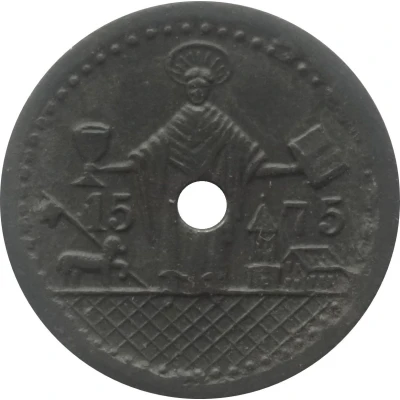
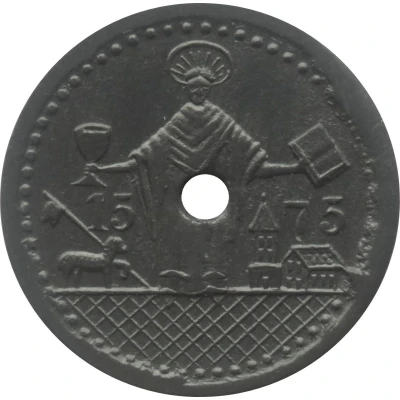
Pearl rim surrounding Monk, Lamb and Church.
Script: Latin
Lettering: 15 75
Edge
Plain
Comment
Issuing body: [Gemeinde, Sachsen-Weimar-Eisenach].
Interesting fact
The 5 Pfennigs - Oldisleben ND coin from the Municipality of Oldisleben (Saxe-Weimar-Eisenach) in the Federal state of Saxe-Weimar-Eisenach, made of Zinc and weighing 1.5g, is interesting because it was minted during a time when Germany was going through a period of hyperinflation. In the early 1920s, the German economy was struggling, and the value of the German mark (the national currency) was rapidly decreasing. As a result, many everyday items, including coins, became scarce, and alternative forms of currency, such as this 5 Pfennigs coin, were introduced to help alleviate the situation. Despite its low value, this coin is a unique piece of history that highlights the economic challenges faced by Germany during that time.