© Willem63 (CC BY-NC-SA)
© Willem63 (CC BY-NC-SA)
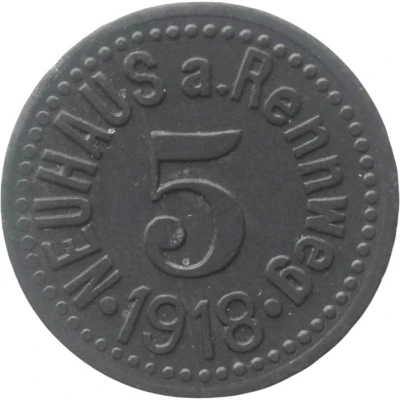
5 Pfennigs - Neuhaus a. Rennweg
1918 year| Zinc | 1.7 g | 18.2 mm |
| Issuer | Municipality of Neuhaus am Rennweg (Schwarzburg-Rudolstadt) (Federal state of Schwarzburg-Rudolstadt) |
|---|---|
| Type | Standard circulation coin |
| Year | 1918 |
| Value | 5 Pfennigs (5 Pfennige) (0.05) |
| Currency | Mark (1914-1924) |
| Composition | Zinc |
| Weight | 1.7 g |
| Diameter | 18.2 mm |
| Thickness | 1.1 mm |
| Shape | Round |
| Technique | Milled |
| Orientation | Medal alignment ↑↑ |
| Demonetized | Yes |
| Updated | 2024-10-04 |
| Numista | N#186556 |
|---|---|
| Rarity index | 92% |
Reverse
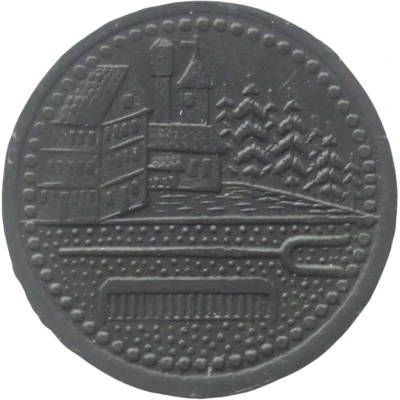
Pearl rim surrounding hunting lodge with church, pitchfork and comb
Edge
Plain
Comment
Issuing agency : [Schwarzburg-Rudolstadt, Gemeinde]
Interesting fact
The 5 Pfennigs - Neuhaus a. Rennweg 1918 coin was issued during a time of economic turmoil in Germany, known as the "Inflationary Period" (1914-1923). During this time, the value of the German mark (the national currency) plummeted, and prices for everyday goods skyrocketed. As a result, many Germans turned to alternative forms of currency, such as local coins like the 5 Pfennigs - Neuhaus a. Rennweg 1918, which were issued by municipalities and local governments. Despite being made of zinc, a relatively inexpensive metal, these coins were highly valued by the local population due to their scarcity and the need for a stable medium of exchange. Today, these coins are highly sought after by collectors, serving as a tangible reminder of a tumultuous period in German history.