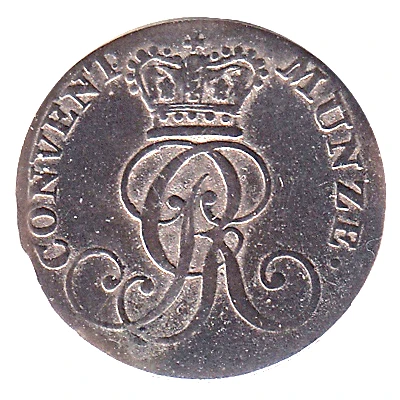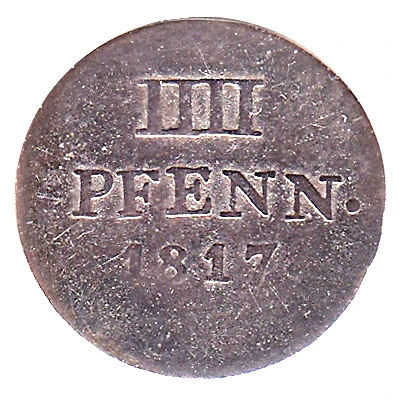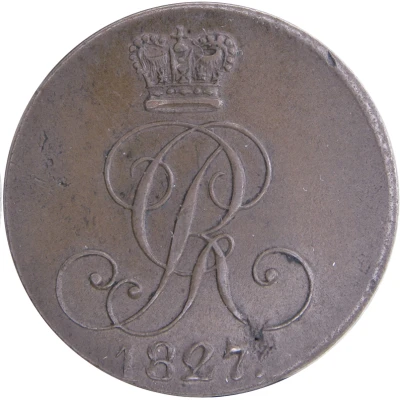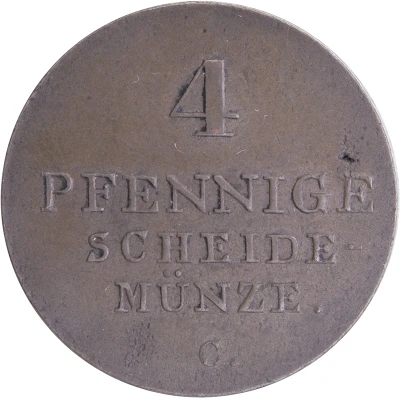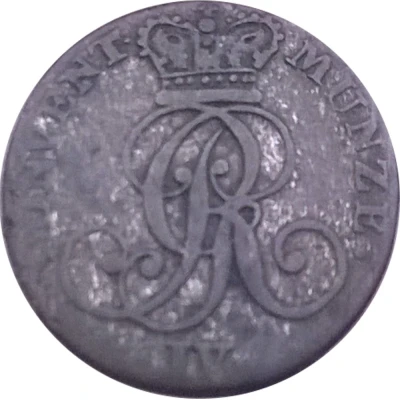
4 Pfennigs - George IV
| Billon (.187 silver) | 1.25 g | 16 mm |
| Issuer | Kingdom of Hannover (German States) |
|---|---|
| King | George IV (1820-1830) |
| Type | Standard circulation coin |
| Years | 1822-1830 |
| Value | 4 Pfennig = ½ Mariengroschen (1⁄72) |
| Currency | Thaler (1814-1866) |
| Composition | Billon (.187 silver) |
| Weight | 1.25 g |
| Diameter | 16 mm |
| Shape | Round |
| Orientation | Medal alignment ↑↑ |
| Demonetized | Yes |
| Updated | 2024-10-05 |
| Numista | N#67039 |
|---|---|
| Rarity index | 76% |
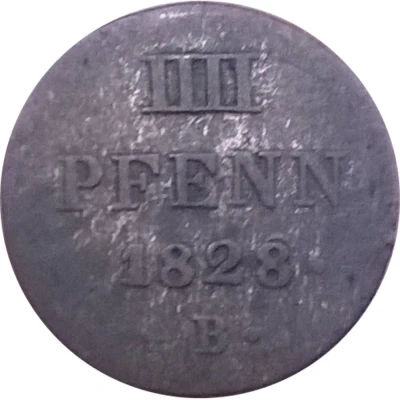
Reverse
4-line inscription with value, date and mintmark.
Script: Latin
Lettering:
IIII
PFENN.
1828.
B.
Edge
Plain
Interesting fact
One interesting fact about the 4 Pfennigs coin from the Kingdom of Hannover is that it was minted during a time of economic turmoil in Germany. The coin was introduced in 1822, and its low value and small size made it a convenient means of exchange for everyday transactions. However, the coin's value was frequently adjusted due to inflation, and by the late 1820s, it was worth only a fraction of its original value. Despite this, the coin remained in circulation until the mid-1830s, when it was eventually replaced by a new currency. This coin's history highlights the economic challenges faced by Germany during this period and the efforts made to address them through monetary reform.