© noumea
© noumea
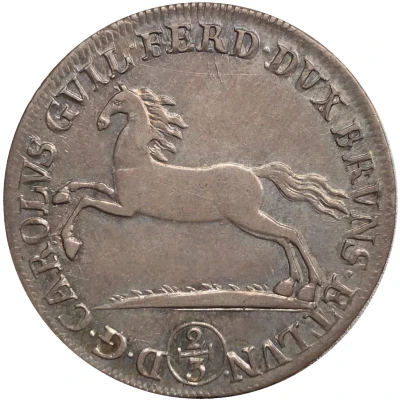
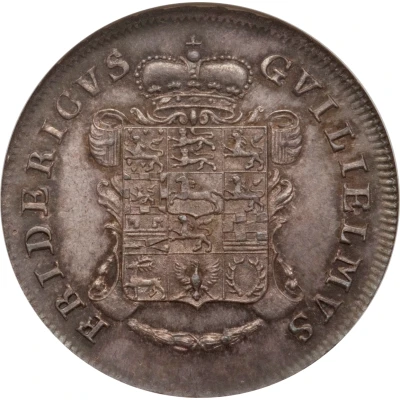
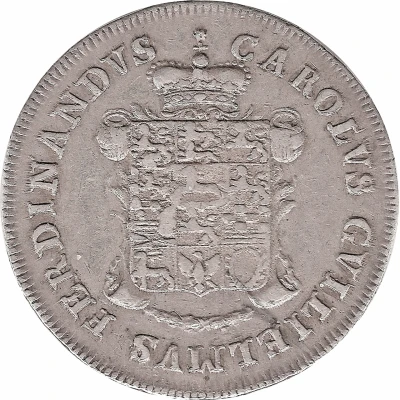
24 Mariengroschen - Charles William Ferdinand
| Silver (.993) | 13.08 g | 32.5 mm |
| Issuer | Principality of Brunswick-Wolfenbüttel (German States) |
|---|---|
| Prince | Charles II William Ferdinand (Karl II Wilhelm Ferdinand) (1780-1806) |
| Type | Standard circulation coin |
| Years | 1801-1806 |
| Value | 24 Mariengroschen (⅔) |
| Currency | Thaler (1499-1814) |
| Composition | Silver (.993) |
| Weight | 13.08 g |
| Diameter | 32.5 mm |
| Thickness | 2 mm |
| Shape | Round |
| Technique | Milled |
| Orientation | Medal alignment ↑↑ |
| Demonetized | Yes |
| Updated | 2024-10-05 |
| Numista | N#26825 |
|---|---|
| Rarity index | 94% |
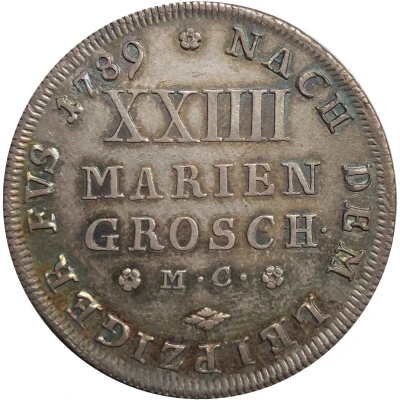
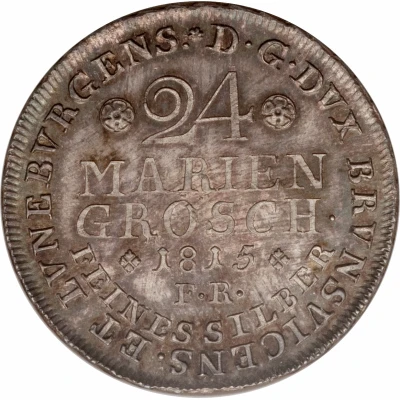
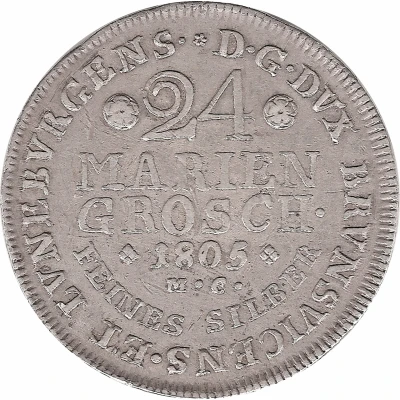
Reverse
Value and date in 5 lines, surrounded by inscription
Script: Latin
Lettering:
D.G.DUX BRUNSVICENS .ET LUNERBURGENS
24 MARIENGROSCHEN
1805 M.C.
FEINES SILBER
Interesting fact
One interesting fact about the 24 Mariengroschen coin is that it was minted during a time of great economic and political change in Europe. The Principality of Brunswick-Wolfenbüttel, where the coin was minted, was part of the Holy Roman Empire, which was dissolved in 1806, just a few years after the coin was minted. This period saw the rise of Napoleon and the French Empire, which had a significant impact on the German states and their economies. Despite these changes, the 24 Mariengroschen coin remained a stable and widely used form of currency in the region.