
10 Soʻm
1994 year| Silver (.999) | 31.1 g | 38 mm |
| Issuer | Uzbekistan |
|---|---|
| Period | Republic (1991-date) |
| Type | Non-circulating coin |
| Year | 1994 |
| Value | 10 Soʻm (10 UZS) |
| Currency | Second soʻm (1994-date) |
| Composition | Silver (.999) |
| Weight | 31.1 g |
| Diameter | 38 mm |
| Shape | Round |
| Technique | Milled |
| Orientation | Medal alignment ↑↑ |
| Demonetized | 1 March 2020 |
| Updated | 2024-10-09 |
| Numista | N#63730 |
|---|---|
| Rarity index | 97% |
Reverse
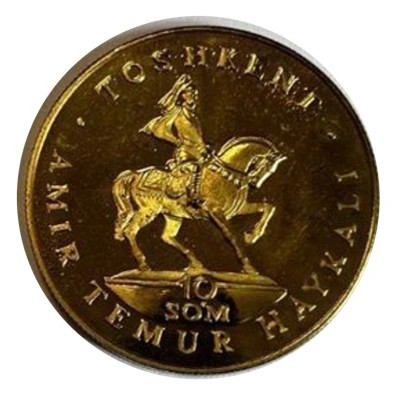
Tamerlane Statue in Tashkent, value below
Lettering:
TOŞKENT
10 SÖM
AMIR TEMUR HAYKALI
Interesting fact
One interesting fact about the 10 Soʻm 1994 coin from Uzbekistan is that it features a unique design that showcases the country's rich cultural heritage. The obverse side of the coin depicts a stylized representation of the mythical bird, Simurgh, which is a symbol of good luck and prosperity in Persian mythology. The reverse side features an image of a traditional Uzbek instrument, the rubab, which is a stringed instrument that is played in many parts of Central Asia. The coin's design serves as a nod to Uzbekistan's rich cultural history and its connection to the region's ancient traditions.
Price
| Date | Mintage | VG | F | VF | XF | AU | UNC |
|---|---|---|---|---|---|---|---|
| 1994 | 1000 | - | - | - | - | - | - |
Values in the table are based on evaluations by sales realized on Internet platforms. They serve as an indication only for 10 Soʻm 1994 coin.