© Willem63 (CC BY-NC-SA)
© Willem63 (CC BY-NC-SA)
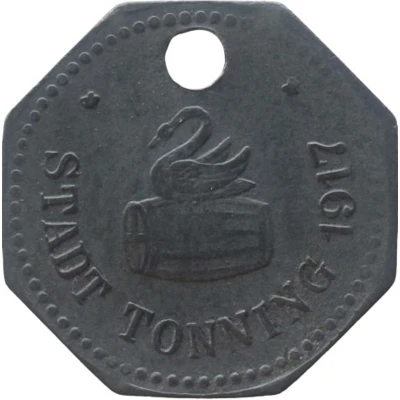
10 Pfennigs - Tönning
1917 year| Zinc | 2.1 g | 20.6 mm |
| Issuer | City of Tönning (Prussian province of Schleswig-Holstein) |
|---|---|
| Emperor | William II (Wilhelm II) (1888-1918) |
| Type | Standard circulation coin |
| Year | 1917 |
| Value | 10 Pfennigs (10 Pfennige) (0.10) |
| Currency | Mark (1914-1924) |
| Composition | Zinc |
| Weight | 2.1 g |
| Diameter | 20.6 mm |
| Thickness | 1.0 mm |
| Shape | Octagonal (8-sided) with a hole (3.0 mm) |
| Technique | Milled |
| Orientation | Medal alignment ↑↑ |
| Demonetized | Yes |
| Updated | 2024-10-04 |
| Numista | N#121869 |
|---|---|
| Rarity index | 94% |
Reverse
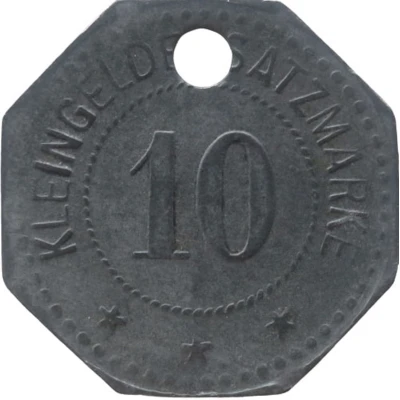
Pearl rim, legend surrounding rope circle with denomination centered.
Script: Latin
Lettering:
KLEINGELDERSATZMARKE
10
★ ★ ★
Edge
Plain
Comment
Issuing agency: [Stadt, Schleswig-Holstein].
Interesting fact
The 10 Pfennigs coin from Tönning (Prussian province of Schleswig-Holstein) made of Zinc weighing 2.1 g is interesting because it was produced during a time of economic hardship and hyperinflation in Germany following World War I. The coin's low denomination and made of a cheap metal like zinc reflects the economic challenges faced by the country during that period. Despite its low value, the coin remains a valuable collector's item and a piece of history for numismatists today.