© Willem63 (CC BY-NC-SA)
© Willem63 (CC BY-NC-SA)
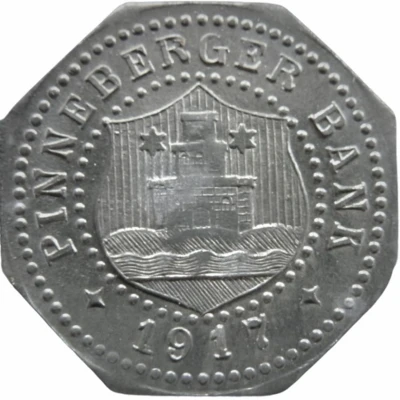
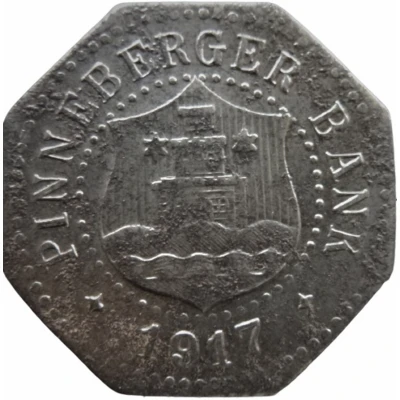
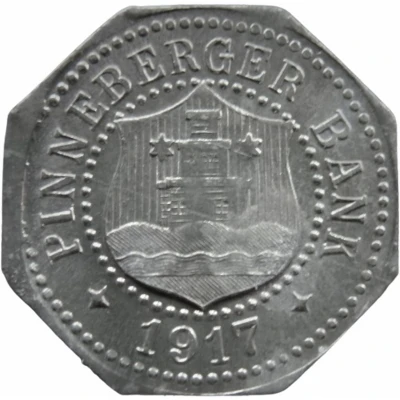
10 Pfennigs - Pinneberg
1917 year| Zinc | 1.8 g | 20.5 mm |
| Issuer | City of Pinneberg (Prussian province of Schleswig-Holstein) |
|---|---|
| Issuing bank | Pinneberger Bank |
| Emperor | William II (Wilhelm II) (1888-1918) |
| Type | Standard circulation coin |
| Year | 1917 |
| Value | 10 Pfennigs (10 Pfennige) (0.10) |
| Currency | Mark (1914-1924) |
| Composition | Zinc |
| Weight | 1.8 g |
| Diameter | 20.5 mm |
| Thickness | 1.0 mm |
| Shape | Octagonal (8-sided) |
| Technique | Milled |
| Orientation | Medal alignment ↑↑ |
| Demonetized | Yes |
| Updated | 2024-10-04 |
| Numista | N#74869 |
|---|---|
| Rarity index | 85% |
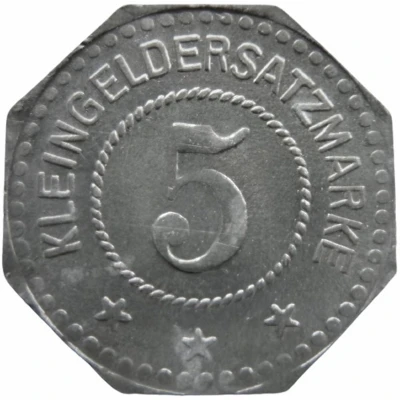
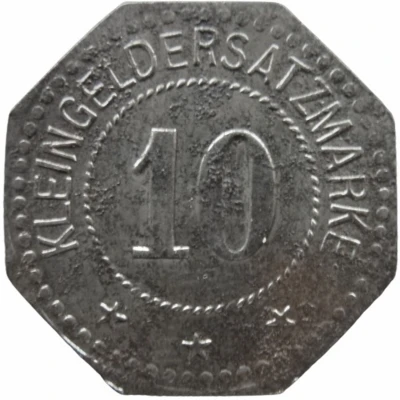
Reverse
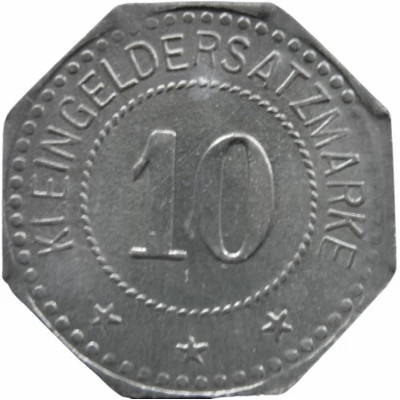
Pearl rim, legend surrounding rope circle with denomination centered.
Script: Latin
Lettering:
KLEINGELDERSATZMARKE
10
★ ★ ★
Edge
Plain
Comment
Issuing body: [Bank, Schleswig-Holstein].
Interesting fact
The 10 Pfennigs - Pinneberg 1917 coin was minted during a time of economic turmoil in Germany, known as the "Inflationary Period" (1914-1923). During this time, the value of the German mark (the national currency) plummeted, and prices for everyday goods skyrocketed. As a result, many Germans turned to alternative forms of currency, such as local coins like the 10 Pfennigs - Pinneberg 1917, which were issued by cities and towns across the country. Despite being made of zinc, a relatively inexpensive metal, these coins were highly valued by the people of Pinneberg and surrounding areas, as they were seen as a more stable store of value than the rapidly depreciating national currency.
Price
| Date | Mintage | VG | F | VF | XF | AU | UNC |
|---|---|---|---|---|---|---|---|
| 1917 | 30000 | - | - | - | - | - | - |
Values in the table are based on evaluations by sales realized on Internet platforms. They serve as an indication only for 10 Pfennigs - Pinneberg 1917 coin.