© Willem63 (CC BY-NC-SA)
© Willem63 (CC BY-NC-SA)
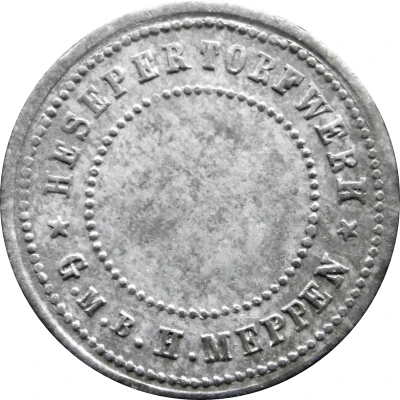
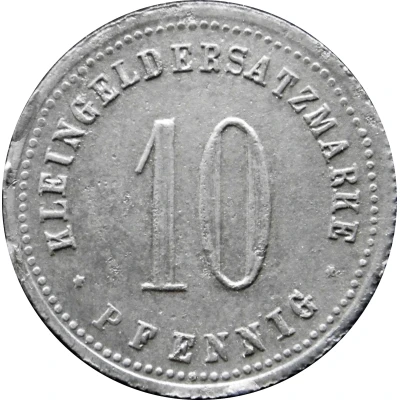
10 Pfennigs - Meppen (Heseper Torfwerk G.M.B.H.) ND
| Zinc | 1.9 g | 21.7 mm |
| Issuer | City of Meppen (Prussian province of Hanover) |
|---|---|
| Type | Standard circulation coin |
| Value | 10 Pfennigs (10 Pfennige) (0.10) |
| Currency | Mark (1914-1924) |
| Composition | Zinc |
| Weight | 1.9 g |
| Diameter | 21.7 mm |
| Thickness | 1.0 mm |
| Shape | Round |
| Technique | Milled |
| Orientation | Medal alignment ↑↑ |
| Demonetized | Yes |
| Updated | 2024-10-04 |
| Numista | N#282555 |
|---|---|
| Rarity index | 94% |
Reverse
Pearl rim, legend surrounding with denomination centered
Script: Latin
Lettering:
KLEINGELDERSATZMARKE
10
★ PFENNIG ★
Edge
Reeded
Comment
Menzel: BBBInteresting fact
One interesting fact about this coin is that it was minted during a time of economic turmoil in Germany. The 10 Pfennigs coin was introduced in 1924 as part of a new currency reform aimed at stabilizing the German economy after the hyperinflation of the 1920s. The coin was made of zinc, a relatively inexpensive metal, due to the economic constraints of the time. Despite these challenges, the coin still features a detailed design, including the Heseper Torfwerk G.M.B.H. (a peat company) building in Meppen, which speaks to the resilience and resourcefulness of the German people during that period.