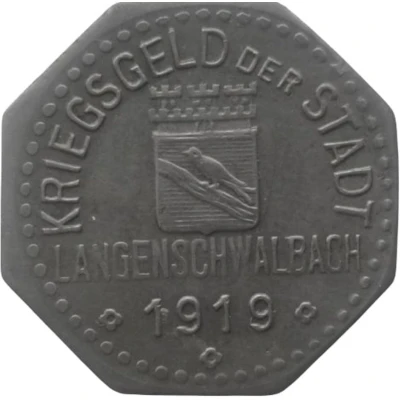
© Willem63 (CC BY-NC-SA)
© Willem63 (CC BY-NC-SA)
10 Pfennigs - Langenschwalbach
1919 year| Iron | 2.60 g | 22.10 mm |
| Issuer | City of Langenschwalbach (Prussian province of Hesse-Nassau) |
|---|---|
| Period | Weimar Republic (1918-1933) |
| Type | Standard circulation coin |
| Year | 1919 |
| Value | 10 Pfennigs (10 Pfennige) (0.10) |
| Currency | Mark (1914-1924) |
| Composition | Iron |
| Weight | 2.60 g |
| Diameter | 22.10 mm |
| Thickness | 1.15 mm |
| Shape | Octagonal (8-sided) |
| Technique | Milled |
| Orientation | Medal alignment ↑↑ |
| Demonetized | Yes |
| Updated | 2024-10-04 |
| Numista | N#179180 |
|---|---|
| Rarity index | 80% |
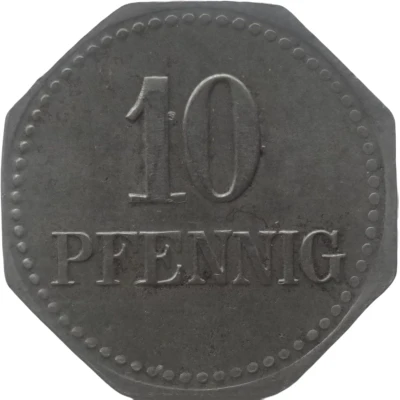
Reverse
Pearl rim. Denomination in center.
Script: Latin
Lettering:
10
PFENNIG
Edge
Plain.
Comment
(Bad) Langenschwalbach is named Bad Schwalbach since 1927.Interesting fact
One interesting fact about the 10 Pfennigs - Langenschwalbach 1919 coin is that it was issued during a time of economic turmoil in Germany, known as the "Inflationary Period" (1914-1923), when the value of the German mark plummeted, and the prices of goods and services skyrocketed. As a result, the government was forced to print more and more money to keep up with the inflation, leading to the creation of many different types of coins, including the 10 Pfennigs - Langenschwalbach 1919, which was made of iron and had a relatively low denomination. Despite its low value, this coin is now considered a rare and valuable collector's item, especially in good condition.