© M. Sander
© M. Sander
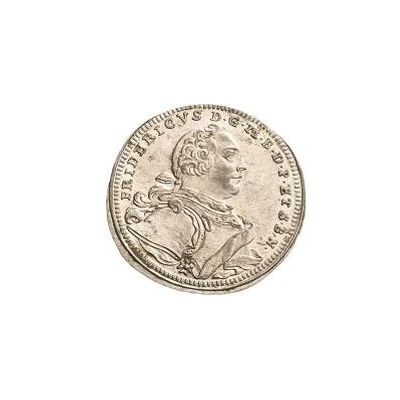
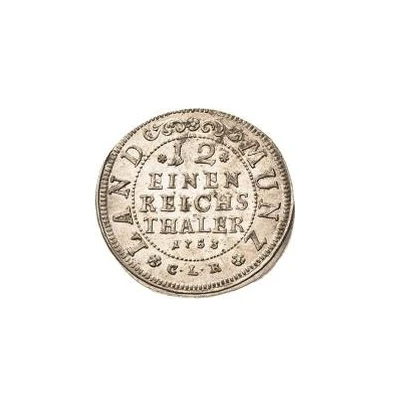
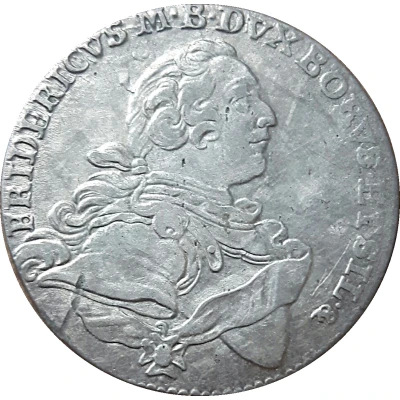
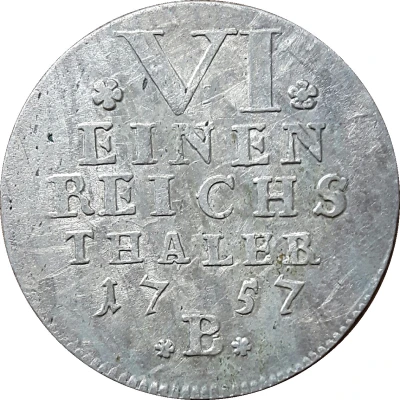
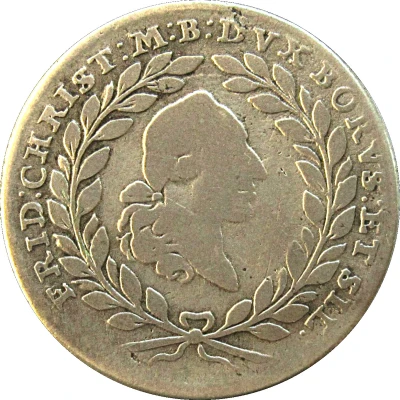
10 Kreuzers - Frederick Christian
| Silver | 3.6 g | 25 mm |
| Issuer | Margraviate of Brandenburg-Bayreuth (German States) |
|---|---|
| Margrave | Frederick Christian (1763-1769) |
| Type | Standard circulation coin |
| Years | 1765-1768 |
| Value | 10 Kreuzers (1⁄12) |
| Currency | Thaler |
| Composition | Silver |
| Weight | 3.6 g |
| Diameter | 25 mm |
| Shape | Round |
| Orientation | Medal alignment ↑↑ |
| Demonetized | Yes |
| Updated | 2024-10-04 |
| Numista | N#87674 |
|---|---|
| Rarity index | 83% |
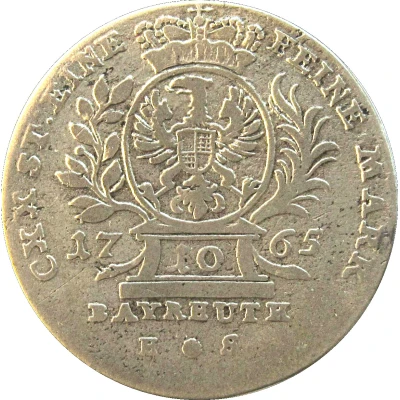
Reverse
Crowned eagle withinoval frame standing on a pedestal between branches. Date separated to the sides and denomination within the pedestal.
Script: Latin
Lettering:
CXX ST: EINE FEINE MARK
BAYREUTH
Edge
Milled
Comment
The "E * S" on the reverse is for:E: Mintmaster Johann Christian Eberhardt
S: Assayer Johann Andreas Schmidhammer
The "C•L•R•" on the reverse is for Mintmaster Christof Lorenz Ruckdeschel
Interesting fact
One interesting fact about the 10 Kreuzers coin from the Margraviate of Brandenburg-Bayreuth is that it was minted during a time of great economic and political change in Germany. The coin was issued during the reign of Frederick Christian, who was the Margrave of Brandenburg-Bayreuth from 1765 to 1768. During his reign, there was a significant increase in trade and commerce, which led to the need for a new coinage system. The 10 Kreuzers coin was part of this new system and was designed to be a more practical and efficient form of currency for everyday transactions. Despite its small denomination, the coin was made of silver, which gave it a high level of value and durability. Today, the 10 Kreuzers coin is a rare and valuable collector's item, providing a fascinating glimpse into the economic and political history of Germany during the 18th century.