© Leipziger Münzhandlung und Auktion Manfred Höhn
© Leipziger Münzhandlung und Auktion Manfred Höhn
⅔ Thaler
1693 year| Silver | - | 37.4 mm |
| Issuer | Franconian Circle (German States) |
|---|---|
| Prince-bishop | Marquard Sebastian Schenk of Stauffenberg (1683-1693) |
| Margrave | George Frederick II (Georg Friedrich II) (1692-1703) |
| Bishop | John Gottfried II of Guttenberg (1684-1698) |
| Period | Free City of Nuremberg (1219-1806) |
| Type | Standard circulation coin |
| Year | 1693 |
| Value | ⅔ Thaler |
| Currency | Thaler |
| Composition | Silver |
| Diameter | 37.4 mm |
| Shape | Round |
| Technique | Milled |
| Demonetized | Yes |
| Updated | 2024-10-05 |
| Numista | N#128164 |
|---|---|
| Rarity index | 95% |
Reverse
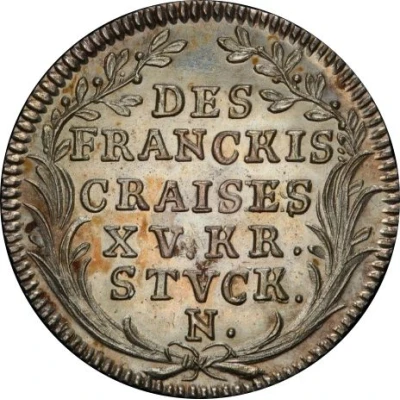
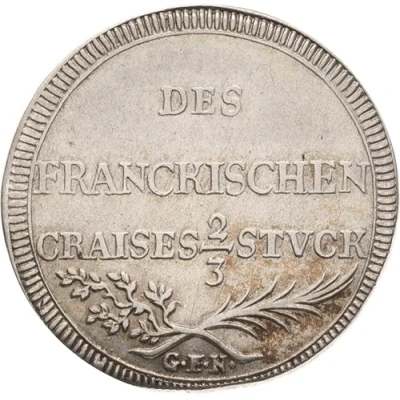
3-line inscription with denomination over laurel and palm branch
Script: Latin
Lettering: DES // FRANKISCHEN // CRAISES 2/3 STVCK
Comment
Helmschrott 463 Slg. Wilmersdörffer 1250Interesting fact
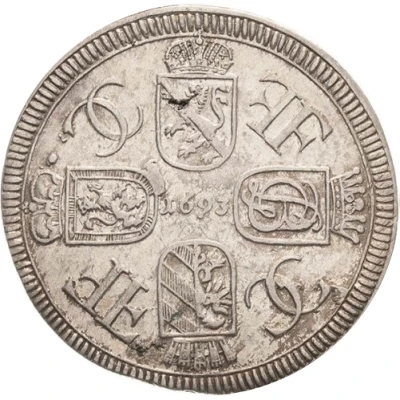
One interesting fact about the ⅔ Thaler coin from the Franconian Circle (German States) made of Silver is that it was minted during a time when the region was experiencing significant economic growth and trade, which led to the need for a standardized currency. The coin's design, featuring the coat of arms of the Franconian Circle on one side and the image of a lion on the other, symbolized the region's strength and unity. Additionally, the use of silver in the coin's minting process was a deliberate choice, as it was a valuable and durable metal that was widely accepted as a medium of exchange. Overall, the ⅔ Thaler coin serves as a fascinating example of early European coinage and the economic developments of the time.